In competitive remote hiring, small advantages decide outcomes. Build a Professional Resume that signals remote readiness, passes automated screens, and proves impact quickly.
Applicant tracking systems filter most applications long before a human review, and remote roles draw outsized interest compared to on-site roles.
Positioning, formatting, and proof of outcomes matter more than flowery claims. Remote job postings capture a disproportionate share of applications, so clarity and evidence must carry every line.
What Hiring Teams Look for First in Remote Resumes
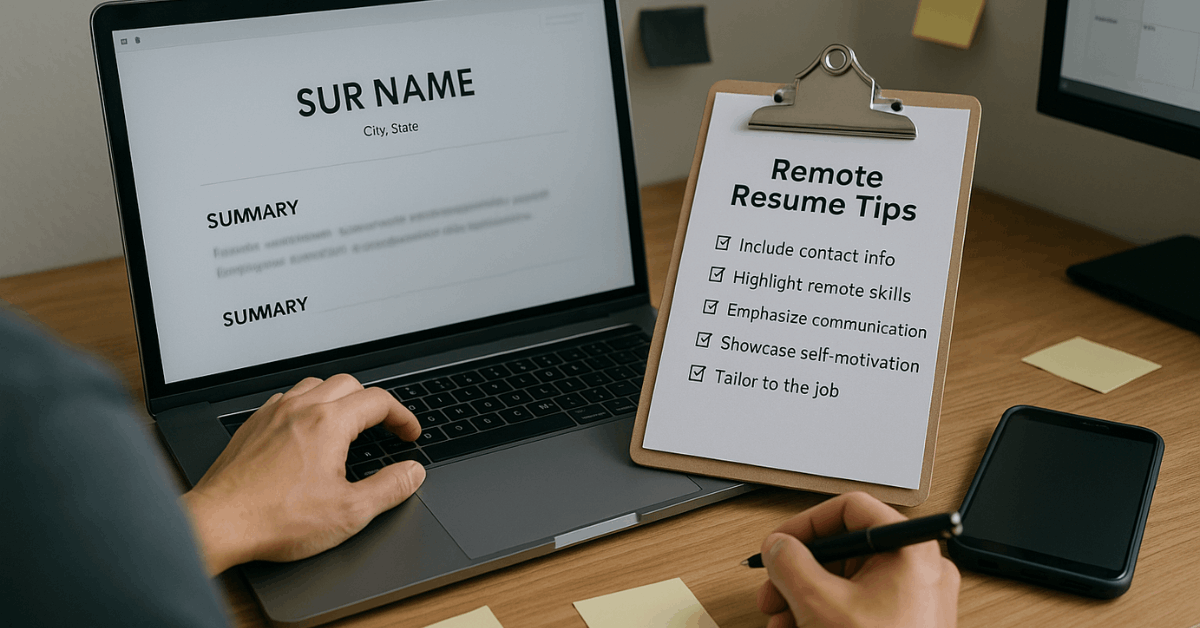
Hiring teams skim for role fit, remote fluency, and measurable results within seconds. Contact details, a tight summary, and the top third of the first page do the heaviest lifting.
Signals that accelerate a yes include clear time-zone or work-authorization notes, familiarity with core collaboration tools, and quantified wins tied to metrics the role owns.
Remote roles remain highly contested, so immediate evidence beats generic statements every time.
Choose the Resume Format that Best Supports Your Story
Clear structure helps reviewers and applicant tracking systems evaluate fit quickly. Three formats lead most applications, and selecting the right one prevents strong content from hiding in the wrong sections.
Keep layout simple, use standard headings, and avoid heavy graphics that can confuse parsing.
Chronological Format
Use this when experience aligns with the target role and work history has minimal gaps. Lead with recent roles in reverse order, keep bullets focused on outcomes, and place skills after experience to reinforce demonstrated results.
Functional Format
Use this when changing careers or returning after gaps. Group achievements under skill clusters like “Customer Support” or “Data Analysis,” then add a compact work history for context. Avoid vague clusters that read like keyword stuffing.
Combination Format
Use this when some experience aligns and skills also need emphasis. Open with a targeted skills snapshot, then showcase recent roles with brief, metric-led bullets.
Craft a Remote-Ready Header and Summary
Start the header with name, email, and phone, then add a location line that clarifies remote intent, for example “Open to global remote, UTC+8.”
Include a portfolio link if work samples exist. A two to three sentence summary should name the target role, years of experience, standout skills, and a signature result.
Add one explicit remote signal such as time-zone coverage, async work, or tool mastery. Keep adjectives limited and verbs specific.
Remote Summary Sample
“Customer support specialist with 5 years across SaaS and fintech, improving CSAT from 4.2 to 4.7 and reducing average handle time 18 percent.
Experienced in asynchronous queues, knowledge-base ownership, and ticket routing in Zendesk. Based in UTC+1, available across US and EU business hours.”
Remote-Focused Skills that Add Proof, Not Noise
Remote work rewards self-management, written precision, and tool fluency. Recruiters skim for proof that these aren’t theoretical.
- Soft skills: time management skills for remote work, asynchronous communication, stakeholder updates, cross-time-zone collaboration, and conflict resolution.
- Hard skills: ticketing or project systems, documentation standards, keyboard-first workflows, security basics for home networks, and remote work tools like Slack and Zoom.
Group soft and hard skills separately, then mirror language from the job description to align with ATS queries. Surveys and practitioner guidance continue to show that most large employers rely on ATS to pre-screen resumes, so exact phrasing maintains discoverability.
Build an ATS-Friendly Resume Template and Keyword Plan
Most Fortune-level organizations route applications through an applicant tracking system that parses headings, dates, and keywords. Use a clean layout, standard section titles, a single-column structure, and common fonts.
Save as PDF unless the employer requests DOCX. Map target keywords from the posting into skills, experience bullets, and job titles where accurate.
An ATS-friendly resume template avoids text boxes, icons, and dense tables that can break parsing. Misconfigured filters sometimes screen out capable candidates; exact phrasing and unambiguous formatting reduce risk on upload.
Quantify Impact and Write Experience Bullets that Scan Fast
Outcome-first bullets outperform duty lists. Lead each bullet with a strong verb, name the lever you pulled, then show the result using real numbers or clear deltas.
Quantify achievements on resume entries even when the data feels small, because concrete movement signals ownership.
Examples that work:
- “Migrated 120 accounts into a shared inbox in two weeks, cutting response times 29 percent.”
- “Launched four lifecycle email flows that raised trial-to-paid conversion from 8 to 11 percent.”
- “Owned weekly async reporting in Notion, reducing status meetings from 5 hours to 2 hours.”
When roles were fully remote, add “Remote” or “Distributed” after the company name. For hybrid roles, mention cadence such as “Hybrid, 2 days on-site,” then focus bullets on remote outcomes like documentation standards, async rituals, or cross-region handoffs.
Education, Certifications, and Useful Additions
Place degrees after experience unless a recent credential drives hiring decisions. Add short lines for certifications that strengthen remote delivery, such as project frameworks, cloud platforms, or security awareness.
Optional sections should earn their space: awards tied to measurable results, publications that build domain trust, or volunteer work that demonstrates collaboration and initiative.
Projects that Prove Self-Direction When Experience is Thin
Side projects, freelance engagements, or open-source contributions reveal remote habits employers value.
Treat projects like mini roles using the same verb-metric structure. Note the stack, the audience, and the result.
Examples include a small web app with active users, documentation merged into a widely used repository, or a community knowledge base with traffic and contributor metrics. Those entries demonstrate transferable skills for remote jobs even without prior payroll remote roles.
Skill Map for Common Remote
Hiring teams skim for patterns that match the role type. Use these quick maps to align emphasis.
- Customer support or success: ticket systems, macros, de-escalation, cohort analysis, retention drivers, async updates.
- Marketing or content: brief intake, editorial calendars, SEO fundamentals, experiment design, attribution basics, stakeholder sign-offs.
- Product or project: backlog hygiene, user stories, acceptance criteria, sprint or Kanban practices, cross-functional alignment.
- Engineering or data: code review discipline, CI pipelines, issue templates, reproducible notebooks, and incident postmortems.
Cover Letter for Remote Position: When and How to Use It
Cover letters still influence interview decisions in many organizations. Multiple surveys since 2024 show that a majority of hiring managers consider cover letters influential or expect them when communication skills matter.
Keep it to one page, center it on the role’s top problems, and point to two or three proof-points the resume raises. Reference one remote practice the team uses publicly, then connect your example to that practice.
Where to Find Legitimate Remote Jobs Without Wasting Time
Start with large networks and curated boards that filter scams and multi-level schemes. LinkedIn’s search filters surface remote roles across regions, while FlexJobs maintains a vetted feed and regular lists of companies hiring remotely.
Niche sites such as We Work Remotely help in engineering, product, and design. Expect tight competition, since a small share of postings attracts a large share of applications across markets.
Tune applications accordingly and target roles where qualifications align tightly.

Remote-Specific Keywords to Place in High-Impact Zones
Targeted keywords help both humans and screening software understand fit. Use these naturally in the summary, skills, and top bullets:
- remote job resume example
- resume for work from home jobs
- ATS-friendly resume template
- transferable skills for remote jobs
- time management skills for remote work
- cover letter for remote position
- remote work tools like Slack and Zoom
- quantify achievements on resume
Avoid keyword stuffing; place each phrase where context makes sense. Recruiters search within applicant databases, so aligned phrasing improves retrieval later.
Proofreading and Final Checks that Prevent Silent Rejections
Simple errors cause preventable rejections in crowded pipelines. Run a final pass that checks spelling, dates, tense consistency, and file naming. Remove novelty icons and headshots unless the region expects them.
Verify time-zone clarity, portfolio links, and contact details. Save a fresh copy for each application that mirrors language in the specific posting.
Remote openings attract many applicants relative to available roles, therefore small mistakes become unnecessary reasons to move on.
Short, Role-Agnostic Template You Can Adapt Today
Use this baseline to organize content quickly, then tailor to each posting.
Header
- Name • Email • Phone • Location or “Remote, UTC±X” • Portfolio or LinkedIn
Summary
- Target title, years, two standout skills, one quantifiable outcome, and one explicit remote signal.
Skills
- Hard skills: systems, languages, platforms, analytics.
Soft skills: communication, prioritization, collaboration, and ownership.
Experience
Company, Role, Location or Remote, Dates
- Verb + lever + metric result bullet
- Verb + lever + metric result bullet
- Process improvement or collaboration bullet
Projects
- Project name, role, tools, result with numbers.
Education and Certifications
- Degree or credential, institution, year, or expected year.
Final Momentum Builders that Compound Results
Small habits improve response rates over a month of consistent applications. Track role requirements and phrasing in a simple spreadsheet, then mirror language precisely when truthful.
Refresh the top three bullets weekly using better metrics or clearer verbs. Add a concise note to recruiters that references one public artifact, such as a changelog, product update, or blog post, and explain how your experience aligns.
Remote hiring favors candidates who show discipline and high-signal communication in every interaction.